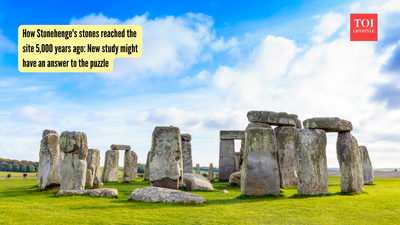
Some places refuse to give up their secrets and mysteries. Stonehenge is one of them. Even at the first glance in a photograph, the ring of giant stones standing alone on an open green land looks like it is hiding something! Maybe a message left by people we will never meet?There have been innumerable theories surrounding the site for centuries, like who built this? Why here? What was it for?But one of the most interesting questions surrounding it is how these stones reach there, as the type of stone constituting the site is not usually found in the region where they stand.Somebody had to bring them there, and some of them came from faraway lands. But how did it happen thousands of years ago, with no engines, no wheels as we know them, and no maps?Recently, scientists turned their attention to one stone in particular, and what they found has only deepened the puzzle. Let’s dig in to find out
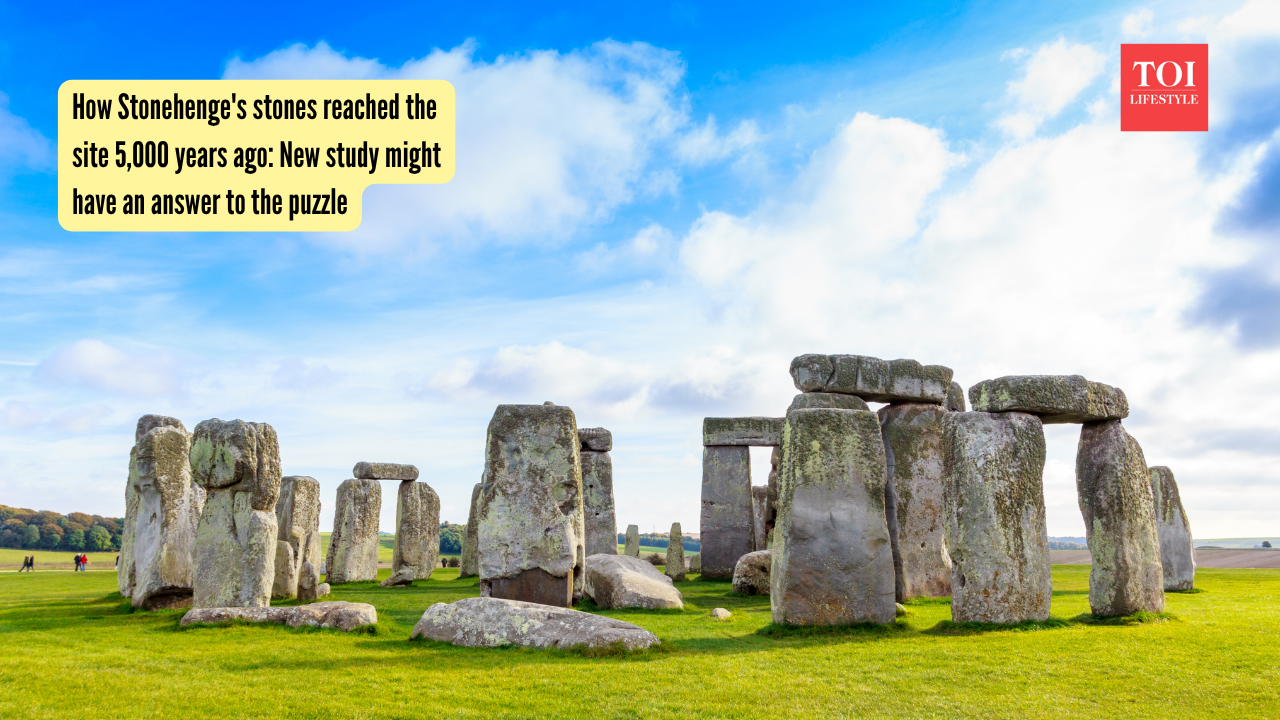
Photo: Canva
Why the ‘Altar stone ’ at Stonehenge might be the most interesting piece of the site
At the heart of Stonehenge lies a flat slab known as the Altar Stone. It is easy to overlook beside the high stones, yet it may be the most intriguing piece of the whole monument. Weighing around six tons and ranging nearly five metres in size, it has confused archaeologists for decades, mainly because it does not seem to belong to the local landscape at all.The stone is a type of sandstone called Devonian Old Red Sandstone, which does not occur naturally near Salisbury Plain, the area of the site. It is like an outsider that sent researchers hunting for its true home. A new study, published in the Journal of Quaternary Science, led by Dr Anthony Clarke of Curtin University, now has a startling answer, that the Altar Stone most likely came from the Caithness coast in northern Scotland, about 700 kilometres away.
How did researchers find it out?
The team reached that conclusion by reading tiny mineral grains called zircons locked inside the rock. Because zircons trap chemical clues when they form, they act like natural record keepers that can survive for hundreds of millions of years. Comparing those signatures with sandstones across Scotland, the closest match came from Sarclet in Caithness, changing a vague guess into a sharper picture.That distance is the longest in comparison to the journeys of Stonehenge’s other stones. Its huge sarsens were brought from West Woods, about 25 kilometres away, while the famous bluestones came from Wales, roughly 230 kilometres away. The Altar Stone, it seems, travelled much farther than any of them.
So how did it get there?
One natural suspect is ice. During the last Ice Age, glaciers dragged rocks across Britain, so the team tested whether a glacier might have done the heavy lifting. Using computer models of ancient ice flow, they found that ice from the stone’s source region mostly moved north and east, which is certainly the wrong way for a trip to southern England. A localised path could have pushed rocks towards Dogger Bank, a stretch of land now drowned beneath the North Sea, but no further.But the timing still does not match it. Dogger Bank was drowned by rising seas between 7,000 and 8,000 years ago, while the Altar Stone reached Stonehenge only around 5,000 years ago. That leaves a gap of thousands of years.
So, was it brought by the humans?
For researchers, the evidence points firmly towards human effort. According to Dr Clarke, “Rather than being carried naturally by ice, the evidence points to a deliberate, carefully planned movement across a challenging and varied landscape.” He suggests the stone was probably moved in stages, combining overland hauling with river or coastal transport wherever possible.It is interesting to consider how this huge stone was made possible to shift. Shifting a six-ton block without trucks or cranes would have demanded a large number of people working as one. As Dr Clarke put it, “Transporting a stone of this size over such a long distance would have required planning, coordination, and a deep understanding of the landscape, not to mention tremendous determination.”