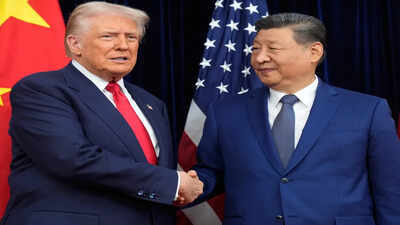
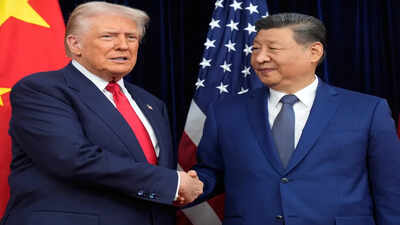
Donald Trump and Xi Jinping
Anthropic has released a new paper on AI competition between the US and China. In the more than 2000-word paper titled ‘2028: Two scenarios for global AI leadership’, Anthropic seeks to explains its views on the competition on AI between the US and China. It says that in the paper, the company presents two scenarios for what the world might look like in 2028, when we expect transformative AI systems to have arrived.“In the first scenario, America has successfully defended its compute advantage. Policymakers have acted to tighten export controls further, disrupt China’s distillation attacks, and further accelerate democracies’ adoption of AI. In this world, democracies set the rules and norms around AI. It’s also in this scenario that we’re most likely to successfully engage with China on safety, which we’re supportive of to the extent this is possible,” says the paper.As for the scenario two, it says, “In the second scenario, America has chosen not to act. Policymakers have not tightened loopholes on the CCP’s access to compute, and AI firms in China have quickly taken advantage—catching up to the frontier and even overtaking America. In this world, AI norms and rules are shaped by authoritarian regimes, and the best models enable automated repression at scale. It will be no solace that this authoritarian triumph has happened on the back of American compute.“
Here are the important excerpts from Anthropic’s paper on China
It’s essential that the US and its allies stay ahead of authoritarian governments like the Chinese Communist Party, or CCP. AI will soon become powerful enough to be used to repress citizens at unprecedented scale, and even to alter the balance of power among nations. And since AI is advancing more quickly by the day, we have only a limited period of time to set the conditions of the competition—and determine whether and how those threats materialize. It’s with this in mind that we outline what’s required to ensure America stays ahead.The most important ingredient for developing AI is access to the computer chips on which the models are trained (or “compute”). Since the most capable chips are developed by American companies, the US government currently limits China’s supply by enforcing tight export controls on them. Recent history suggests these controls have been incredibly successful. In fact, AI labs in China have only built models close in intelligence to America’s because of their talent, their knack for exploiting loopholes around these export controls, and their large-scale distillation attacks that illicitly extract the innovations of American companies.In this post, we present two scenarios for what the world might look like in 2028, when we expect transformative AI systems to have arrived.In the first scenario, America has successfully defended its compute advantage. Policymakers have acted to tighten export controls further, disrupt China’s distillation attacks, and further accelerate democracies’ adoption of AI. In this world, democracies set the rules and norms around AI. It’s also in this scenario that we’re most likely to successfully engage with China on safety, which we’re supportive of to the extent this is possible.In the second scenario, America has chosen not to act. Policymakers have not tightened loopholes on the CCP’s access to compute, and AI firms in China have quickly taken advantage—catching up to the frontier and even overtaking America. In this world, AI norms and rules are shaped by authoritarian regimes, and the best models enable automated repression at scale. It will be no solace that this authoritarian triumph has happened on the back of American compute.America and its allies approach AI competition from a position of great strength. The tools for AI dominance have been built by an exceptionally innovative ecosystem of companies in democratic nations. Our past success means that our present task is largely to avoid squandering our advantage: to decide not to make it easier for the CCP to catch up.
Two scenarios for the US and China in 2028
Democracies, not authoritarian regimes, must lead in AI development and deployment. These countries and political systems can shape the rules and norms that govern these systems.Democracies currently hold a substantial lead in compute, the most important ingredient for developing frontier AI models. That lead exists thanks to American and allied innovation, and to bipartisan US export controls that defend those innovations. But on model intelligence, AI labs in the People’s Republic of China (PRC), under the jurisdiction and control of the Chinese Communist Party (CCP), are not far behind. We focus on the CCP as it is the regime that is most able to use frontier AI to cement authoritarianism; we do not seek to undermine the interests or ingenuity of the Chinese people. Already, the CCP is using AI to censor speech, repress dissidents, hack governments and corporations across the world, and strengthen the People’s Liberation Army (PLA).AI labs in China have world-class talent. It is compute constraints that limit their ability to keep up. Labs in China have remained close by exploiting loopholes in US export control policies, and by carrying out large-scale distillation attacks that harvest the innovations of US models in order to mimic their capabilities.With the supply of compute expanding rapidly, and with AI being used increasingly to augment the training of new AI models, we’re entering a period of great acceleration in AI capabilities. The “country of geniuses in a data center”—the level of intelligence we associate with transformative AI—may be close at hand. This acceleration makes policy action more urgent. To date, by allowing export control evasions and distillation attacks, we have let the CCP’s AI efforts trail closely up the frontier curve. But if the US and its allies act now to address both issues, it may be possible to lock in a 12-24 month lead in frontier capabilities. A lead that large by 2028 would be enormously advantageous. Such a lead would also augment efforts to engage with AI experts in China on AI safety and governance, which we support. But the window of opportunity to lock in that lead will not necessarily remain open for long.Here, we present two potential scenarios for the state of US-China AI competition in 2028. The first scenario is one in which democracies have established a commanding lead in model intelligence, adoption, and global distribution. This scenario can be achieved if policymakers act now to tighten controls on advanced compute to PRC labs, disrupt their efforts to distill America’s best AI models, and accelerate democracies’ adoption of AI.The second scenario is one in which the CCP is competitive at the near-frontier. This scenario happens if policymakers don’t build on our existing lead, or if they loosen restrictions on access to compute for PRC firms.Many in Congress and the Trump administration have championed export controls, curbing distillation attacks, and exporting American AI. In advancing these policies, we are hopeful that democracies can secure a commanding lead by 2028, and avoid a destabilizing neck-and-neck race with the CCP two years from now.The imperatives of staying aheadWe expect frontier AI to have transformational economic and societal impacts in the coming years, as described in Machines of Loving Grace and The Adolescence of Technology. Our mission is to ensure that humanity navigates the transition to transformative AI safely and beneficially. We believe that a successful transition can lead to astonishing breakthroughs in medicine, invention, and economic growth.The threat of authoritarian AIWhether that transition goes well depends in part on where the most capable systems are built first. The political systems in which the most advanced AI is created will shape the rules and norms for how the technology is developed and deployed. In turn, those rules and norms will help determine whether the technology is safe, whose security it protects, and whose interests it ultimately serves. We believe that responsibility should rest with democratically elected governments, not authoritarian regimes.If the frontier is set by regimes that treat AI as an instrument of repression, military advantage over democracies, and domestic control, the transition is less likely to go well, for those regimes’ own citizens or anyone else.Historically, the reach of authoritarian rule has been limited by its dependence on human enforcers to carry out surveillance and repression. Powerful AI systems may remove that dependency, enabling automated repression on a far greater scale. For that reason, the prospect of the CCP leading in AI is among the greatest threats to a successful transition.The CCP holds enormous power and influence at the helm of China’s economy, military, and the largest authoritarian state structure on Earth. It is also the only country besides the US with well-resourced, highly talented AI labs chasing the frontier. Furthermore, the CCP is highly motivated to establish China as the leading AI power. Beijing has poured tens of billions of dollars into China’s AI and semiconductor sectors.Already, the CCP uses AI systems to censor speech, enforce draconian policies on ethnic minorities, and hack major corporations and government agencies. The CCP’s vision of AI-enabled techno-authoritarianism has been extensively documented in Xinjiang, where state security agencies have systematically deployed facial recognition technology, biometric data collection, and communications surveillance, enabling repression at a scale that humans alone could not achieve. Frontier AI systems will make those capabilities cheaper to maintain, far more pervasive, and more sophisticated. The CCP’s export of these technologies has enabled autocrats in other countries to more effectively stifle dissent, entrenching authoritarianism. A CCP-led AI frontier could dramatically strengthen repression around the world.AI is a dual-use technologyFrontier AI will shape the future military balance. CCP leadership already operates on that premise, and is building its military for an AI-enabled battlefield. PLA strategists view the “intelligentization” of their military forces as the means with which to catch up and eventually surpass the US military. The PLA is already procuring commercially developed Chinese AI systems for military use, including DeepSeek models deployed to coordinate swarms of unmanned vehicles and enable cyber offense capabilities. These capabilities will not diffuse slowly. When a new model reaches a new capability in autonomous targeting, vulnerability discovery, or swarm coordination, for example, the regime that controls it can put it onto the field in weeks, not years.The risk compounds because frontier AI will be an accelerant for other critical technologies. Advanced AI models will be able to compress research and development (R&D) cycles in semiconductors, biotech, and advanced materials. A lead in frontier AI will enable a widening lead across the full national security technology stack.If a PRC AI lab had developed a model at the level of Claude Mythos Preview before an American one, the CCP would have had first access to a system that can autonomously discover and chain software vulnerabilities, which it could have used to further penetrate critical American infrastructure. Future models will be exponentially more capable, and therefore have commensurately greater implications for the national security interests of the US and other democracies.Neck-and-neck competition risks disincentivizing responsible AIA neck-and-neck race between American and Chinese AI labs could make industry and government-led safety and governance efforts more difficult, and less likely. If PRC labs are either close behind or at par with models in the US, private AI firms in the US and China are likely to feel more pressure to release new models and products faster, without taking prudent pre-deployment safety measures. Governments could become reluctant to enact policies to encourage responsible AI development and deployment, for fear of falling behind.While increasing numbers of researchers in China’s AI labs and policy community are concerned with AI safety risks, this trend has not translated into safety practices on par with labs in the US. As of last year, only 3 out of 13 top Chinese AI labs published any safety evaluation results, and none disclosed evaluations for Chemical, Biological, Radiological, and Nuclear (CBRN) risks. The Center for AI Standards and Innovation (CAISI) found that DeepSeek’s R1-0528 model complied with 94 percent of overtly malicious requests under a common jailbreaking technique, compared with 8 percent for US reference models. This pattern has continued in more recent releases. For example, an independent assessment of Moonshot’s Kimi K2.5 published in April found that the model failed to refuse CBRN-related requests at a far higher rate than US frontier models. Compounding the problem, labs in China often release dual-use capable models as open-weight. Once a model is open-weight, safeguards that do exist can be removed, making the model available to any state or non-state actor to use for malicious purposes, including the cyber and CBRN misuse those safeguards were built to prevent.Our policy objective: creating and maintaining a lead for democraciesWe support policies in the US and other countries that build and maintain a safe, near-term lead over the CCP in intelligence, domestic adoption, and global distribution. This lead is key to avoiding authoritarian AI leadership and protecting the national security interests of the US and other democracies. Doing so is a fundamental prerequisite to ensuring that democratic states can achieve favorable terms with authoritarian states.Anthropic deeply respects the Chinese people and the accomplishments of the Chinese AI community. We hope for peaceful relations between China and the world. Our concerns are specifically with the risks to humanity posed by any powerful authoritarian political systems with access to frontier AI systems.Opportunities for engagement on AI safetyAnthropic supports international AI safety dialogue with AI experts in China, when possible. The world has a vested interest in safe AI, regardless of where it is developed and deployed. There are a range of risks that could emerge from frontier AI systems requiring engagement between the US and China. Efforts that identify shared challenges and advance ideas to prepare for and mitigate these risks are in our shared interests.The prospects for productive engagement are best when the US maintains a large capabilities advantage. Responsibly building a lead in developing and deploying the most advanced AI augments our ability to influence AI safety in China and elsewhere.The Mythos Preview wake-up callMythos Preview, a model that we released to select partners as part of Project Glasswing in April, signals the arrival of an acceleration period that makes policy action even more urgent. With access to the model, Firefox was able to fix more security bugs last month than it had in all of 2025, and almost 20 times more than its monthly average security bug fixes in 2025. In response to the model, one PRC cybersecurity analyst wrote that China is “still sharpening our swords while the other side has suddenly mounted a fully automatic Gatling gun.”Frontier AI capabilities will quickly approach the “country of geniuses in a datacenter” portrayal of transformative AI. This acceleration will be driven by the logic of scaling laws, in which model performance improves predictably with increases in computing power and data inputs, and by AI itself increasingly being used to accelerate the development of new models.There is a high likelihood that we will look back on 2026 as the breakaway opportunity for American AI. American labs have the most advanced AI models, a large lead in both the quantity and quality of the advanced AI chips required to push the frontier, and a colossal capital advantage from revenues and financing to back the necessary investments to achieve it. PRC labs have real strengths: world-class, innovative talent, abundant and cheap energy, and plenty of data. All are requirements for developing frontier intelligence. But they simply do not have sufficient domestic compute to compete, nor do they have the revenues and capital to fund it.Four fronts of the competitionThe US and China are engaged in a competition for strategic advantage in frontier technologies like AI. Statements from both Beijing and Washington reflect that view. Calling that competition a “race” can give the false impression that there is a finish line, after which one side will conclusively secure victory. Rather, the competition will be an ongoing contest for advantage, in which either democracies or authoritarian regimes successfully position themselves to shape the values, rules, and norms of an AI-enabled future.
This competition is playing out on four fronts:
Intelligence: which countries develop the most capable AI models.Domestic adoption: which countries integrate AI most effectively across commercial and public sectors.Global distribution: which countries deploy the global AI stack on which the world economy runs.Resilience: which countries sustain political stability through the economic transition.Intelligence is the most important of the four fronts. We anticipate that frontier model capabilities will drive the most consequential changes for geopolitical competition. Model capabilities are also a primary driver of market adoption and global distribution.But intelligence alone is not sufficient. If the CCP integrates near-frontier AI systems quicker and more effectively into China’s economy and the CCP security apparatus, and drives global adoption of subsidized, low-cost AI, then it could secure advantages over democracies that overcome an intelligence deficit. Beijing’s AI+ Initiative and its focus on “embodied intelligence” accordingly put high priority on policies that advance the integration of frontier intelligence into their economy and state apparatuses. The Trump administration’s AI Action Plan, and its focus on “promoting the export of the American AI technology stack,” also speaks to the strategic advantage of driving global adoption.While we won’t focus on it in this essay, we believe resilience will be an important front of AI competition. Being able to sustain stability, cohesion, and good policymaking in this period will be a critical advantage, and a vulnerability for those who cannot.The state of the competitionCompute—the advanced semiconductors needed to train and deploy frontier AI—is an essential input on each front of the competition described above. The race for global AI leadership is in large part a race for compute. For more than a decade, model capability has scaled with compute, and the majority of performance gains in AI capabilities have historically come from simply using more of it. Moreover, compute is needed to serve customers’ use of AI (also known as “inference” capacity), not just to train new models. Compute will be critical both for training the most intelligent models and for deploying them in commercial and national security spheres. Access to top talent, copious amounts of data, and critical algorithmic advances all matter to the race for intelligence—but each of those inputs is irrelevant if the compute is insufficient.Democracies are winning the competition for compute leadership today. While some worry that export controls could accelerate the CCP’s own efforts to develop an advanced chip supply chain, little evidence suggests that China’s indigenization efforts will challenge US and allied leadership in advanced compute technology. Beijing has invested enormous resources into China’s chip sector, with major industrial policy initiatives like the Made in China 2025 strategy and the China Integrated Circuit Industry Investment Fund launched years before the imposition of export controls. Despite this state-backed investment, PRC AI labs and chipmakers remain stymied by US and allied export controls on advanced chips and chipmaking equipment.As a result, the compute gap appears to be widening. An analysis of Huawei and NVIDIA’s roadmaps found that Huawei will produce just 4 percent of NVIDIA’s aggregate compute in 2026 in total processing performance, and 2 percent in 2027. Moreover, NVIDIA represents only part of the US and allied compute ecosystem, with Google and Amazon ramping up production of their own chips (TPUs and Trainium, respectively) to meet demand from American frontier AI labs and their customers.Further exacerbating their compute shortfalls, China has made little progress in many of the most technologically complex segments of the semiconductor supply chain. Without access to extreme ultraviolet (EUV) technology, and even more so if policymakers can close loopholes on deep ultraviolet (DUV) technology and servicing and maintenance thereof, China’s chipmakers will remain unable to manufacture chips in sufficient quantity or quality to challenge US compute leadership. China’s inability to manufacture high-bandwidth memory at scale further exacerbates this gap. If the US strengthens its restrictions on the CCP’s ability to access US compute, one study estimates that America will have access to roughly 11 times more compute than China’s AI sector.How democracies built the lead: commercial innovation and smart public policyThere are two main reasons for the compute lead. The first is the incredible innovation of companies like NVIDIA, AMD, Micron, TSMC, Samsung, ASML, and others across democracies like Japan, South Korea, Taiwan, the Netherlands, and the US, who together have built the unique technologies in the world’s most advanced semiconductors. Today’s AI achievements would not be possible without the feats of engineering and decades of sustained R&D investments that contributed to these products.The second reason is forward-looking, decisive policy action across the last three presidential administrations. Bipartisan policy action has protected the US and allied innovation engine by restricting access to the US AI stack by PRC firms under the jurisdiction of the CCP. Our CEO has publicly commented on the importance of export controls, for example. These controls have curbed the sale of the highest-end AI chips and semiconductor manufacturing equipment (SME) to China over the last several years, constraining China’s frontier AI development even as Beijing has poured enormous state resources into the sector. Without action to limit China’s access to US compute, the CCP would have had all the ingredients to develop AI at par or superior to America’s.Some observers worry that constraining access to compute will force AI labs in China to innovate on other axes, reducing the American lead. While PRC labs are innovating, these innovations are so far not sufficient to overcome their compute deficit. Algorithmic improvements are both a function and a multiplier of compute, not a substitute for it, and discovering those advances is itself a compute-intensive process: more compute enables labs to run more experiments, which enables labs to discover more algorithmic improvements. As frontier models increasingly conduct AI R&D themselves, that loop will tighten further, and frontier models will help build their own successors. In short, compute advantage compounds into algorithmic advantage, and from there into a durable lead in AI itself.Today, US frontier systems are estimated to be at least several months ahead of the top models from PRC AI labs on intelligence, though these estimates are necessarily uncertain. Despite the attention paid to open-weight models from China, their enterprise adoption lags closed frontier models, and monetization concerns have surfaced among public investors. Moreover, AI labs in China seem to be moving away from open source, now choosing to keep their best models proprietary.China’s own AI leaders confirm the impact of export controls, and the critical need for US chips. Executives at top PRC AI labs have expressed worries that China will fall further behind due to compute constraints. Top Chinese labs cite compute scarcity as a chief constraint to accelerating model capabilities, and they identify export controls as the reason for this constraint. One executive of a China-based hyperscaler called the impact of supplying export-controlled US chips to China “huge, really huge,” adding that any supply gap severely impacts China’s AI development and dismissing concerns that importing U.S. chips would slow their self-sufficiency efforts. The primary voices in China suggesting export controls are futile seem to be CCP officials and state media, likely angling to influence US policymakers.How the CCP stays competitive: policy loopholes remainWhile export controls have been effective in providing today’s advantage, they have not gone far enough. Despite the CCP’s inability to manufacture enough advanced chips domestically or purchase them legally abroad, AI labs in China have been able to stay close on intelligence through two workarounds: illicit and evasive compute access, by smuggling AI chips directly into China and accessing offshore data centers, and illicit model access, through which they carry out distillation attacks on US frontier models and use those same models as tools to accelerate their own AI R&D.China’s evasion of US export controls is an open secret. For example, federal prosecutors charged a Supermicro co-founder and two others with diverting $2.5 billion worth of servers containing advanced US chips to China. According to US government and media reports, DeepSeek trained its latest model on advanced US chips that are banned from sale to China. The Financial Times reported that Alibaba and ByteDance now train their flagship models on export-controlled US chips in data centers located in Southeast Asia, a route current controls do not reach because US export law covers the sale of chips, not remote access to them.1 The US export control system is struggling to prevent PRC AI labs’ access to advanced US-origin compute.Distillation attacks, in which China-based labs create thousands of fraudulent accounts to circumvent access controls on US AI models and systematically harvest their outputs to replicate frontier capabilities, are another illicit technique used by PRC labs to catch up to their US counterparts and blunt the impact of export controls. The practice allows labs based in China to free-ride on decades of foundational research, billions of dollars in US investment, and the work of thousands of the world’s best engineers that produced US frontier models. The result is near-frontier capability at a fraction of the cost, subsidized by the United States. It is systematic industrial espionage of a technology critical to long-term US national security interests. OpenAI, Google, Anthropic, and the Frontier Model Forum have all publicly condemned the practice of distillation attacks.AI experts in China openly acknowledge distillation attacks’ scale and importance to China’s AI development. A recent article in a state-owned media outlet described distillation attacks on US models as the “back door” China’s AI labs depend on as a core part of their business model. An ex-ByteDance researcher said that PRC AI labs use distillation as a shortcut to train models, allowing them to avoid investing into their own data pipelines.US policymakers have moved quickly to address this threat. The White House Office of Science and Technology Policy published a memo on distillation attacks. Senior officials in the White House, Department of War, and members of Congress have also called attention to this problem. Recent legislation from the House Foreign Affairs Committee to address distillation attacks passed out of committee unanimously.If policymakers in the US and allied democracies act to close these two channels propping up China’s AI models—illicit and evasive compute access and illicit model access—then we have a potentially once-in-a-generation opportunity to secure our lead.