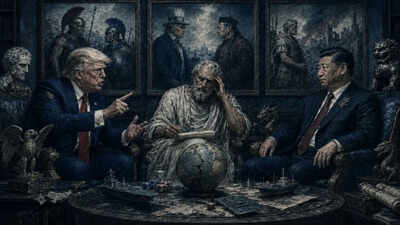
Quote of the day by Banksy (AI-generated image)
There are some quotes people read once and immediately move on from. Then some lines stay in the mind for hours because they touch something deeply human and slightly uncomfortable at the same time.This quote by Banksy belongs in the second category.It does not sound dramatic in the usual motivational quote way. There are no grand promises about success, positivity, or changing the world. Instead, the line quietly forces people to think about memory, legacy, and what actually remains after a person is gone.And honestly, it feels even heavier in the age of social media.People today leave behind thousands of photos, messages, videos, tweets, and digital traces. Entire lives now exist online in ways previous generations could never imagine. Yet despite all that visibility, many still worry about being forgotten. That fear appears everywhere once people start noticing it.The quote captures that feeling with surprising simplicity.Death, according to Banksy’s line, is not only physical. There is another kind of disappearance that happens later, when memories slowly fade, and somebody’s name is spoken for the final time.It is a haunting idea. Probably because most people instinctively understand it.
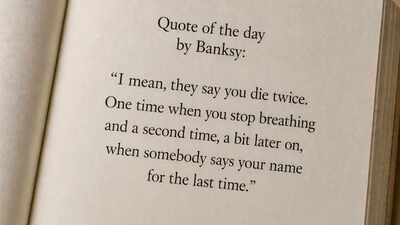
Quote of the day by Banksy
“I mean, they say you die twice. One time when you stop breathing and a second time, a bit later on, when somebody says your name for the last time.”
Why this quote feels different from most internet-famous quotes
A lot of viral quotes online are designed to sound uplifting immediately. Banksy’s quote does the opposite. It slows people down.The line feels conversational, almost casual at first. “I mean, they say…” sounds like the beginning of an ordinary discussion rather than a philosophical statement. That relaxed tone makes the final idea land even harder.The quote also avoids sounding polished or overly poetic.That is probably part of why it spread so widely online. It feels human. Almost like something somebody says quietly late at night during a serious conversation.And unlike many inspirational quotes, this one does not offer an easy solution. It simply points toward a truth many people already sense but rarely discuss openly.Most human beings want to matter to somebody.Not necessarily to millions of strangers. Sometimes just to family, friends, or the people whose lives they touched along the way.
Who is Banksy
Banksy is one of the most famous and mysterious artists in the world. Despite global recognition, Banksy’s real identity has never been officially confirmed, which only increased public fascination over the years.The anonymous British street artist became known for politically charged graffiti, dark humour, anti-establishment commentary, and artwork appearing unexpectedly in public spaces. Banksy’s pieces often combine satire with emotional or social criticism. Some are funny at first glance before becoming unsettling a few seconds later.That emotional contrast appears in many of the artist’s most famous works.Art critics and cultural commentators have spent years analysing Banksy’s themes: consumerism, war, capitalism, fame, surveillance, inequality, and human behaviour. Yet one reason Banksy became so popular outside the art world is that the messages rarely feel academic. The ideas are usually direct enough for ordinary people to connect with immediately.This quote works similarly.The language is simple. The emotional impact is not.
What does the quote by Banksy actually mean
Banksy’s quote separates death into two stages.The first death is physical. A person stops breathing. Their life ends biologically.The second death happens later, when memory disappears too. Eventually, there comes a final moment when somebody speaks that person’s name for the last time. After that, they vanish completely from living memory.That second idea is what makes the quote so powerful.It shifts attention away from mortality alone and toward remembrance. Human beings have always cared deeply about being remembered in some form. Ancient civilisations built monuments partly for that reason. Families pass down stories for generations because memory itself feels important.The quote quietly suggests that memory keeps people alive in a different sense.As long as someone remembers a person, tells their stories, laughs about old memories, or repeats their name, part of them still exists socially and emotionally.Once that disappears, another kind of death occurs.
Why the quote hits harder in the digital era
Modern life created a strange relationship with memory.People now document almost everything. Birthdays, holidays, conversations, meals, relationships, achievements, even ordinary daily moments. Social media turned memory into something constantly archived online.At first glance, that might seem comforting. Digital traces appear permanent. But the internet also moves incredibly fast.A viral celebrity today may become forgotten surprisingly quickly. Online fame often disappears within months. Even major cultural moments can vanish beneath endless new content. The speed of digital culture sometimes makes memory feel fragile rather than permanent.That tension probably explains why Banksy’s quote resonates so strongly today.People are surrounded by constant visibility but still fear disappearing emotionally. The quote speaks directly to that anxiety without saying it outright.
The fear of being forgotten feels deeply human
Most people do not talk openly about this fear, but it exists quietly underneath many human behaviours.Some want children partly because family stories continue through future generations. Others chase artistic success, achievements, books, businesses, or public recognition because they hope something lasting remains after they are gone.Even ordinary people preserve memories constantly. Photo albums. Voice notes. Old letters. Saved messages.Family recipes. Tiny emotional archives that help people hold onto somebody’s presence.Loss often makes this clearer.After someone dies, small details suddenly become precious. The way they laughed. A phrase they repeated constantly. Their handwriting. Old photographs that nobody paid much attention to before.Memory becomes emotional survival in a way. Banksy’s quote captures that entire feeling in one sentence.
Why the line feels emotional without sounding sentimental
One reason the quote spread so widely online is that it avoids exaggerated emotion.Banksy does not say “never forget me” or describe grief dramatically. The line stays restrained and conversational. That subtlety makes it stronger.It feels observational rather than manipulative.People often connect more deeply with understated sadness because it resembles real life more closely. Grief usually arrives quietly. Memory fades slowly, too. Families gradually stop mentioning certain stories. Generations pass away. Names disappear from conversations without anybody consciously deciding it.The quote recognises that process honestly.That honesty is probably what makes readers pause after seeing it.
Banksy often mixes humour with darker truths
This quote fits a pattern visible throughout Banksy’s work.Many of the artist’s murals initially appear playful or ironic before revealing something heavier underneath. A child holding balloons suddenly becomes commentary about loss or innocence. A humorous visual joke transforms into criticism about politics or modern society.Banksy’s style often relies on contrast.Humour beside sadness. Simplicity beside the uncomfortable truth.This quote works similarly. It begins casually, almost like an everyday conversation, before leading readers into a deeply existential idea about mortality and memory.The emotional shift happens quietly.That subtle approach makes the line far more memorable than dramatic philosophical writing would have been.
Why people share quotes about memory and legacy
There is probably a reason quotes about remembrance spread so widely online.People want reassurance that their lives matter beyond routine survival.Work deadlines, bills, notifications, and daily stress can make life feel repetitive sometimes. Quotes like this interrupt that rhythm for a moment. They remind readers that human relationships, memories, and emotional impact may ultimately matter more than temporary achievements.The quote also changes how people think about legacy.Legacy is often imagined as fame or an enormous accomplishment. Banksy’s line suggests something smaller and more personal. Being remembered lovingly by even a handful of people becomes meaningful in itself.That idea feels surprisingly comforting once the initial sadness fades.
Why this quote will probably stay relevant for years
Some quotes fade because they only fit a specific trend or moment. Banksy’s line touches something permanent about human existence, which is probably why it continues circulating online year after year.Every generation fears loss.Every generation worries about memory fading.And every generation searches for ways to leave something meaningful behind, even if that “something” is simply being remembered by the people they loved.The quote does not offer easy comfort. It does not pretend that death becomes less painful through philosophy alone. Instead, it quietly points toward another truth sitting beside mortality itself: human beings continue existing through memory for longer than they physically remain here.Perhaps that is why the line lingers in people’s minds.A person’s final disappearance does not happen immediately. It happens slowly. Conversation by conversation. Memory by memory. Until one day, somewhere, somebody says their name for the very last time.