The ancient Mediterranean is often imagined as a collection of separate kingdoms, each rising and falling largely on its own terms. Archaeology has been steadily dismantling that picture. What has emerged instead is a far more connected world, one tied together by trade routes, diplomatic agreements, royal marriages and the movement of materials across remarkable distances.The collapse that unfolded around 1177 BC has long been treated as one of history’s great mysteries. Cities were abandoned, palaces burned, political systems disappeared,d and international trade contracted sharply. Yet recent archaeological research suggests the story may be less about the sudden destruction of individual kingdoms and more about the failure of an interconnected system. That shift in perspective is changing how scholars understand both the collapse itself and the nature of ancient trade networks.
How interconnected trade networks may have triggered the 1177 BC collapse
According to archaeologist Eric Cline in his study published in ScienceDirect, titled “Are civilisations destined to collapse? Lessons from the Mediterranean Bronze Age”, the eastern Mediterranean during the Late Bronze Age was one of the most interconnected regions of the ancient world. Egypt, the Hittite Empire, Babylonia, Assyria, Cyprus, the Mycenaean kingdoms, the Canaanite cities and others maintained relationships that extended far beyond occasional commerce.Letters exchanged between rulers reveal diplomatic negotiations, requests for assistance and the movement of luxury goods. Archaeological finds point to an equally extensive commercial network. Copper from Cyprus, tin from regions far to the east and manufactured goods from different kingdoms moved through a system that stretched across thousands of kilometres.As Cline explained in a lecture for the Long Now Foundation, this was a period in which prosperity depended heavily on connections. The bronze that gave the age its name could not be produced without access to materials from multiple regions. Trade was not an optional activity operating at the edges of society. It sat at the centre of economic and political life.
How drought, conflict and famine contributed to the 1177 BC collapse
For many years, attention focused on the so-called Sea Peoples, groups mentioned in Egyptian records that appeared during a period of widespread upheaval. Their attacks were often presented as the primary explanation for the collapse.That interpretation has become harder to sustain as more evidence has accumulated. As Cline argues, the archaeological and textual record points towards multiple pressures arriving within a relatively short period. Contemporary letters describe food shortages and social strain. Environmental studies have identified evidence for prolonged dry conditions across parts of the eastern Mediterranean. In some areas, there are indications of earthquakes and destruction linked to conflict.Rather than searching for one event that brought everything down, researchers increasingly view the collapse as the outcome of several disruptions interacting with one another. A society facing drought might still survive. A kingdom recovering from conflict could continue functioning. The difficulty emerged when numerous stresses affected connected regions at the same time.
The trade network failure behind the 1177 BC collapse
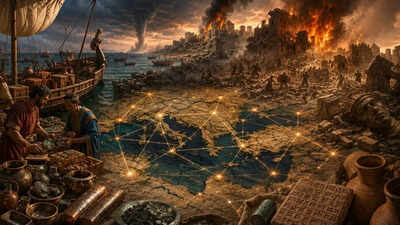
As per the study published on ScienceDirect, approached the problem from a different angle. Instead of concentrating on individual kingdoms, researchers mapped the Late Bronze Age as a network of political and commercial relationships. Their model incorporated major powers including Egypt, the Hittites, Assyria, Babylonia, Cyprus, Crete, mainland Greece and the trading centre of Ugarit.The results challenged a common assumption. The network proved surprisingly resilient when only a single major state was removed from the system. In most simulations, the broader structure remained intact. Problems appeared when several important centres failed together.The researchers found that certain combinations of collapse could trigger cascading effects across the network. In particular, the loss of both Ugarit and the Hittite Empire created a chain reaction that spread through neighbouring regions before eventually affecting larger powers. The significance of this finding lies not simply in identifying vulnerable points but in demonstrating how interconnected systems can appear stable until multiple failures occur at once.
The interconnected world behind the 1177 BC collapse
What emerges from this work is a picture of trade networks that were both strong and fragile. Their strength came from connectivity. Access to distant resources encouraged economic growth, cultural exchange and political cooperation. These connections allowed societies to achieve levels of prosperity that would have been difficult through local resources alone.Yet the same links also created dependencies. If several major hubs encountered serious difficulties simultaneously, disruptions could spread well beyond the original crisis. As Cline explained in a lecture for the Long Now Foundation, the relationships that supported growth may also have transmitted instability when conditions deteriorated.That insight has altered how archaeologists view the events surrounding 1177 BC. The collapse is increasingly seen not as the destruction of isolated kingdoms but as the breakdown of a complex international system. Ancient trade networks were not merely routes for moving goods. They formed the framework through which economies, governments and societies functioned.The archaeological evidence suggests that the Late Bronze Age world was more interconnected than once believed. Its collapse, rather than being a mystery caused by a single invading force, now appears to reflect the vulnerabilities that can emerge when prosperous societies become deeply dependent on one another. The story of 1177 BC is therefore not only about what was lost. It is also about how closely linked the ancient world had already become long before the modern age.