Gold prices have crashed around 30% from their all-time peaks seen in January this year. Silver is down more than 50%! At present, gold is trading at a seven month low in international markets.In January 2026, gold prices hit $5595 – a life-time high – they are now trading at below $4,000. The prices are down 7.6% year-to-date. On the MCX, the decline has been lesser – at around 22% – largely due to a hike in import duties.After a record breaking rally for most of last year, gold prices seem to be letting off some steam. But why? Gold is always seen as a safe haven asset in times of global uncertainty, but the US-Iran war has triggered a slide that has refused to stem even after crude oil prices have fallen.
Why are gold prices down?
Gold prices are down due to multiple macroeconomic factors that are weighing on bullion sentiment. The US-Iran war triggered a spiral that has not ended, despite crude oil prices dropping to pre-conflict levels. The hawkish stance of the US Federal Reserve and a strengthening dollar have all reduced gold’s safe haven appeal.
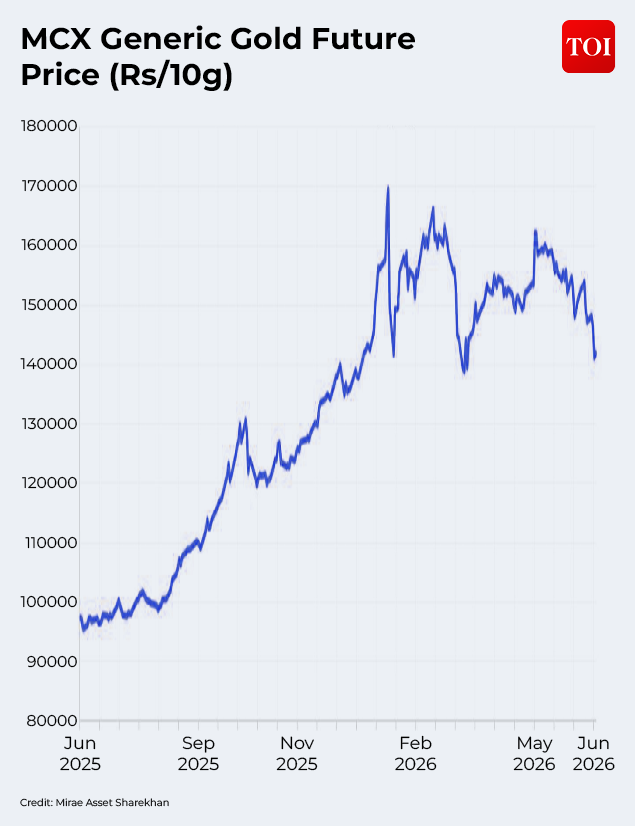
MCX Gold price trend
Praveen Singh, Head of commodities at Mirae Asset ShareKhan shares some of the major factors that have led to the crash:
- Triggered by the Iran war, a geopolitical-driven energy shock has translated into renewed inflation concerns, prompting a sharp repricing in interest rate expectations. Prior to the escalation in Middle East tensions, markets were pricing in more than two rate cuts; this has now shifted toward expectations of roughly 40 basis points of tightening by year-end, reflecting a more hawkish policy outlook. Markets see the US Federal Reserve hiking rates in October this year and March next year.
- Why should that matter? It does because gold is a non-yielding asset; it doesn’t earn any income. Rate hikes tend to make bonds more attractive and also strengthen the US dollar.
- Gold has also failed to benefit from safe-haven demand, as inflation concerns stemming from elevated oil prices have instead fuelled expectations of tighter monetary policy.
- Even as oil prices have moderated, central banks remain cautious and are pivoting away from accommodative stances to anchor inflation expectations.
- The US Dollar Index has strengthened to a multi-year high, adding further downward pressure on gold.
- The US economy’s reduced sensitivity to oil shocks has helped contain downside growth risks, limiting recession fears despite higher energy prices. Consequently, recession probabilities over the next 12 months remain contained, reducing the urgency for safe-haven allocations.
- Continued ETF outflows reflect weakening investor sentiment, with holdings declining by 3.6 Moz since the onset of the conflict and net outflows of 1.63 Moz year-to-date.
- Elevated price volatility and positioning-driven moves have also discouraged fresh buying interest.
When will gold recover?
Experts see near-term volatility and decisions on rate hikes influencing the outlook of gold prices.“In the near term, volatility may persist with corrective selloffs. However, the broader outlook remains positive, supported by potential economic slowdown, geopolitical risks, and eventual monetary policy easing. Prices may stabilize and recover once rate hike pressures ease and dollar strength moderates,” Hareesh V, Head of Commodity Research, Geojit Investments Limited tells TOI.He sees gold prices finding support at around Rs 1.29 lakh per 10 grams.“In the international market, spot gold is likely to find immediate support near $3,850, while resistance is seen around $4,630. Similarly, in the domestic MCX market, prices are expected to hold support near Rs 1,29,000 per 10 grams, with resistance placed at Rs 1,56,000. These levels indicate a range-bound movement in the near term, with any breakout dependent on macroeconomic cues such as US dollar strength and interest rate expectations,” he says.Vedika Narvekar, Research Analyst – Commodities & Currencies, Anand Rathi Shares and Stock Brokers expects gold to trade in the Rs 1,35,000–1,54,000 per 10 gm range on MCX for the third quarter of this calendar year.“Considering the ongoing negotiations between the US and Iran and the recent decline in crude oil prices, we do not expect the hawkish guidance (of US Federal Reserve) to fully materialize,” she says. “Much will depend on incoming economic data, particularly inflation and employment figures. In the short term, after the sharp sell-off, we cannot rule out the possibility of short covering. However, any upside in gold is likely to be limited to the $4,250–4,360/oz range,” she tells TOI.Vedika Narvekar believes silver is also likely to witness a short-covering or relief rally, with prices potentially rebounding towards $64/oz in the spot market and Rs 2,25,000/kg on MCX in the near term.“However, from a medium-term perspective, we expect silver to remain within a broad range of $52–68/oz in the spot market and Rs 1,95,000–2,56,000/kg on MCX,” she says.On a weekly basis, Maneesh Sharma, Commodity expert says that gold still has room to witness more downside to an extent of 5–8% as continued strength in the dollar index amid rising US yields for coming weeks is expected to keep pressure on gold prices intact.This may lead gold to find support in the range of $3,740–3,580 / Oz while on MCX downside still exists up to Rs 1,38,000–136,500 per 10 gm. in August futures contract. He recommends accumulating gold as further 4–6% downside from current levels creates an opportunity for long term investments in yellow metal.“In the last 50 years gold has historically gained an average of 1.5%-1.8% in August. This summer rally is widely attributed to rising physical demand and positioning ahead of the end Q3 festive and wedding seasons in India,” he tells TOI.(Disclaimer: Recommendations and views on the stock market, or any other asset classes or personal finance management tips given by experts and analysts are their own. These opinions do not represent the views of The Times of India.)